Tiny guns might seem at first sight to be a sort of novelty item, pocket-sized, able to be held on a fingertip, frequently in a glass case or the collection of a gun-collector. But to call them curiosities is to ignore their importance. These works exist at the border of mechanical engineering, historical preservation, craftsmanship, and telling of cultural stories. Since the miniature firearms are made from small bullet guns that can shoot real bullets, to the most finely crafted non-firing models, the same principles, challenges, and craftsmanship of full-size firearms are reduced to unbelievably small sizes.
Amateurs and collectors who are attracted to the world of tiny weapons usually start out with mere fascination. That interest is further enhanced soon after finding that a good number of these objects are not toys but rather functioning machine that have tolerances so finely wrought that they are comparable to luxury watchmaking. Others are smaller versions of the most famous historical guns, whereas others utilize the boundaries of physics and machining to make what many would claim is the smallest gun in the world.
A Brief History of Miniature Firearms
Mini guns are not a new product of a new culture. They can be traced back hundreds of years, and they were directly related to the development of gunsmithing as a whole. Scale-down firearms were made as markers of mastery as long as the 17th and 18th centuries. These works were frequently offered to the royalty, patrons or guilds as showcase works- practical testaments that the artisan was well aware of all the mechanics of a firearm.
These early miniatures were mostly working in many situations. The development of a firing mechanism on a smaller scale demanded extensive expertise in the field of metallurgy, the tension of springs, and ignition mechanisms. One wrong step would make the whole work useless. This led to the miniature guns being a symbol of mastery as opposed to mass produced objects.
Other curiosities and personal defense items that came into existence during the 19th century were tiny guns pistol and revolver. Some were sold with secrecy particularly to travelers or the individuals who wanted to keep it a secret. Although they can be seen as small real guns by modern collectors, they could be categorized as being somewhere in between practicality and novelty historically.
These historical foundations today give tiny real weapons richness that cannot be reproduced by modern imitations. All of the pieces narrate a story not only of war or self-defense, but of craftsmanship, innovation and cultural values of its era.
Engineering at the Edge of Possibility
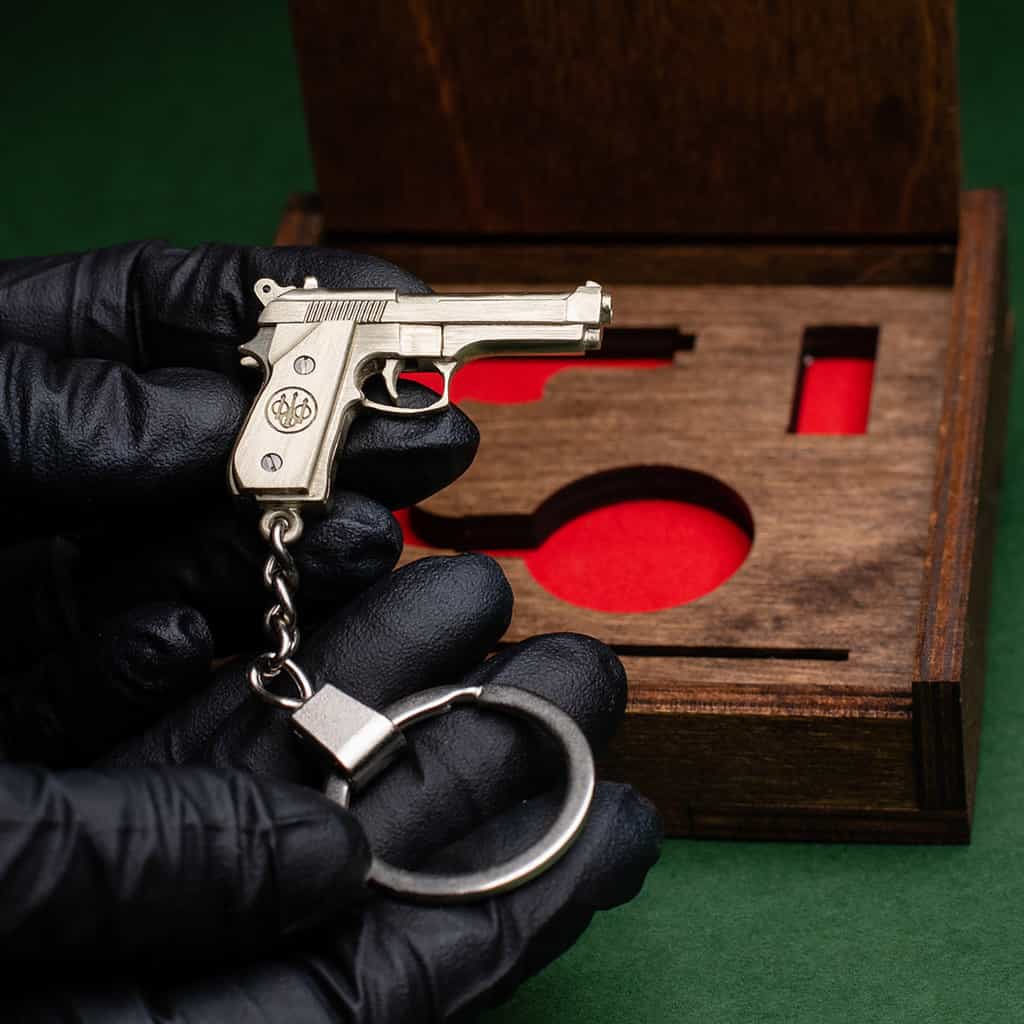
The craftsmanship of tiny bullet guns is possibly the strongest argument that these items surpass the conventional collection items. Reducing a firearm is not an easy task of reducing the size in proportion. Scaling of mechanical forces is not even-handed and the result is that designers have to re-engineer almost all the components anew.
Tolerances are of the order of the microscopic in the instance of the smallest working gun. Springs are to provide accurate tension without taking. The striking force pins should be sufficient to heat a primer but not so large that they do not fit in a chamber the size of a pin-point. Barrels should be rifled–or deliberately smooth–at diameters scarcely to be seen by the naked eye.
A lot of functional miniature guns utilize custom micro-calibers that have been created in smaller size. Even ammunition is an engineering achievement and is frequently made by hand as a way of guaranteeing uniformity and safety. Such accuracy would put miniature firearms in the same category as high quality horology, micro-mechanics and aerospace parts.
Even non firing miniatures require exceptional attention to detail. All screw-slots, lines of engraving, and curves should be made to perfection, to give the effect of scale. It is the reason why miniature guns of high quality are never low-end items; they are a product of mechanical craft.
The Tiniest Gun in the World: Myth, Reality, and Records
The word smallest gun in the world is such an immediate point of interest and with reason. On average, every year a number of firearms have been competing with this informal title, each of which stretches the mechanical limits of what can be achieved. Such guns are usually less than an inch in length and the ammunition is so small that it takes magnification to study.
The difference between these guns is not only their size, but also their functionality. To be a real contender of the title, an individual should be able to launch a projectile with a self-contained cartridge and a mechanically functional firing system. That is why the tiniest functioning gun in the world is not just a curiosity, but a breakthrough in engineering.
These works are appreciated by collectors not just because of their rarity, but also because they can symbolize the ultimate bounds of mechanical miniaturization without contemporary digital production technology. Possessing such a gun is like possessing a prototype of human ingenuity an instrument to always remember that innovation does not have to be large to be effective.
Legal and Ethical Considerations
Small guns will exist in an ambiguous legal environment that differs greatly depending on a nation and a location. An object is not exempted by size as per gun law. In the event that a miniature gun can discharge live bullets, it can legally be regarded as a firearm, no matter how small it can be.
Even tiny real guns and the functional miniature firearms, many of which are tiny, often carry permits, registration or licensing under local laws. Even non-firing replicas may be restricted in certain locations and areas to the extent that they have a close resemblance to working weaponry.
Ethical ownership is an essential part of tiny weapons firearms community. Quality collectors insist on secure storage, proper paperwork, and appropriate exhibition. To prevent the legal issues most opt to purchase non-firing or deactivated models to enjoy the art and history that these items embody.
Knowing the law is not just a joke- it is an element of honoring the tradition and duty that accompanies the process of owning guns, of any size.
Miniature Firearms as Investment Assets
Other than passion and appreciation, miniature firearms are more and more being looked at in terms of alternative investment assets. Small production batches, artisanal production and historical importance all lead to appreciation in the long term.
Miniature firearms, particularly those of well-known workmen, or of a symbolic design, often perform better than mass-made collectibles. The market of the tiniest working gun in the world, such as is the case, is highly niche, which induces scarcity and demand at the same time.
Condition, provenance and originality have decisive roles in valuation. The returns would be stronger in the long term when the purchaser records purchase history, maintenance and authenticity. Like with fine art or rare watches, there is knowledge that will distinguish between a speculative buyer and an informed investor.
Cultural Impact and Modern Collecting Communities
The emergence of online forums and community groups of collectors has caused miniature firearms to cease being a fringe curiosity and have become the subject of conversation on the global stage. Techical breakdowns, historical research and restoration methods are shared by enthusiasts and this has created a culture of learning instead of merely buying.
The miniature guns are also found in museums, uncritical collections and scholarly discourse on industrial design and mechanical evolution. They question the scales, functions and purposes- making the viewers question what constitutes relevance in an object.
In such communities, small weapons are not valued to be aggressive and used to fight, it is a matter of ingenuity. This difference is essential in the explanation of why miniature guns are rather being respected and not becoming a thing of the past.
Practical Applications Beyond Display
Although most miniature guns are made to be displayed, some of them have educational and demonstrative purposes. Students of gunsmithing learn using scaled models, as they can learn internal mechanisms but not handle full-size firearms. They are examined by engineers to understand issues of miniaturization that can be used in other sectors.
Miniatures that are historically accurate are also used in reenactment, film making and in academics. They enable a close analysis of the designs of weapons used in the past without any logistical issues of carrying or storing full-sized weapons.
Minority guns in such situations serve as instruments of analysis and conservation, but not merely ornamentation.
FAQs about Miniature Gun
-
Are miniature firearms real guns or just replicas?
Miniature firearms can be either fully functional or non-firing replicas. Functional models qualify as real firearms under many laws, while replicas are purely decorative.
-
What is considered the smallest working gun in the world?
The title typically refers to a firearm capable of firing live ammunition while measuring under one inch in length, using a custom micro-caliber cartridge.
-
Are tiny real guns safe to own?
When handled responsibly and stored properly, they can be safe. However, due to their size, they require extra care and strict adherence to legal and safety guidelines.
-
Do miniature firearms increase in value over time?
High-quality, limited-production miniature firearms often appreciate in value, especially those with historical relevance or exceptional craftsmanship.
-
Can miniature firearms be legally shipped internationally?
International shipping depends on the firearm’s functionality and destination laws. Many collectors prefer deactivated models to simplify logistics.
Conclusion
Mini guns defy our sense of worth, size, and use. They are not characterized by their size, but by the experience, experience, and accuracy that they represent. These objects are neither art nor machinery, as the engineering wonders producing the smallest gun or the cultural communities keeping their traditions are all limited to this very position.
Being valued as historical artifacts, mechanical accomplishments, and long-term investments, miniature firearms demonstrate that size does not matter. To collectors who like their collections to be authentic and crafted, and have a rich experience, collections by established brands, such as W.Polah Miniature Firearm Models, are a way to enter this amazing world, where even the smallest details can tell the most amazing stories.